Oblique Coordinate Systems: Cartesian and Polar
In this article, we introduce oblique coordinate systems. These are generalizations of rectangular and polar coordinate systems, typically obtained by rotating one or both of the axes. We also introduce our suite of tools—including our proprietary graphing calculator—which comprises the world’s only graphing tools capable of plotting in oblique coordinate systems—those with skew (slanted) axes.
Oblique Cartesian Coordinate Systems
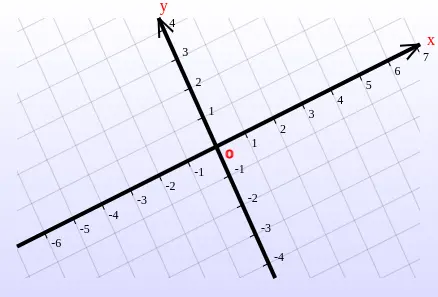
The standard Cartesian coordinate system, often called the rectangular coordinate system, utilizes two perpendicular axes: one horizontal and one vertical. By rotating either of these axes independently, we create a Cartesian coordinate system where the axes intersect at an arbitrary angle rather than a fixed 90°. This is known as an oblique Cartesian coordinate system, as demonstrated in Fig 1, which stands in contrast to the rectangular coordinate system shown in Fig 2.
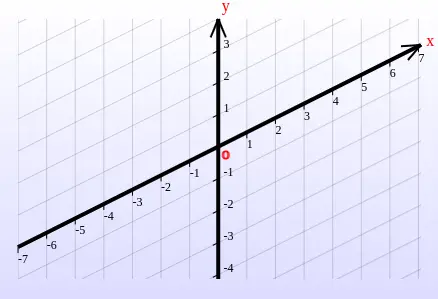

Our oblique graphing calculator and other oblique graphers are the only graphing tools that allow you to rotate axes and plot within oblique Cartesian coordinate systems. This offers an interactive way to explore and master graphing in more generalized coordinate environments. While many texts use "Cartesian coordinate system" and "rectangular coordinate system" interchangeably, we prefer the more precise term rectangular Cartesian coordinate system to distinguish it from the oblique Cartesian coordinate systems introduced here.
In the context of Cartesian coordinates, both rectangular and oblique coordinate systems are types of parallelogrammic coordinate systems. This naming is due to the parallelograms formed by grid lines, which remain parallel to the corresponding axes. Following the same logic that all rectangles are also parallelograms, rectangular coordinate systems are also parallelogrammic coordinate systems.
Remark: It is important to note that when both axes are rotated by the same angle—preserving their perpendicularity, as shown in Fig 3—the system remains rectangular. It does not become "skew", even though the axes are tilted relative to the standard horizontal and vertical orientations.
Oblique Polar Coordinate Systems
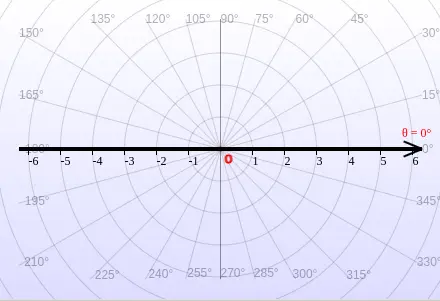
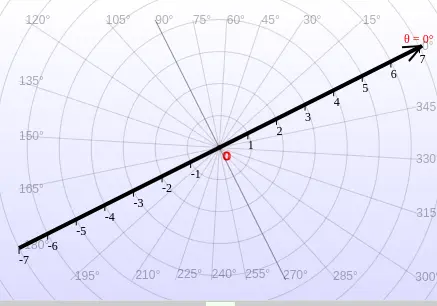
In the standard polar coordinate system (Fig 4), the polar axis is traditionally fixed horizontally, extending to the right from the pole (origin). However, our polar graphing calculator and other polar graphers allow you to redefine this reference by rotating the polar axis to any arbitrary angle. This flexibility allows you to plot points, functions, and complex mathematical expressions in an oblique polar coordinate system.