
Conversion between Cartesian and Polar Coordinates
An ordered pair (a,b) typically locates a different point in Cartesian versus polar coordinate systems (assuming they share the same origin). To illustrate this, try plotting a point—for example, (1,1)—using our dedicated Cartesian and polar points plotter or our versatile graphing calculator. This raises the question: Given a point's coordinates in one system, what are its coordinates in the other?
To answer this question, we assume that in the Cartesian coordinate system, the independent axis is horizontal and the dependent axis is vertical. We also assume that the polar axis coincides with the positive x-axis and shares the same origin. Finally, we assume that both the Cartesian (x and y) axes and the polar axis have the same scale.
Converting Cartesian to Polar Coordinates
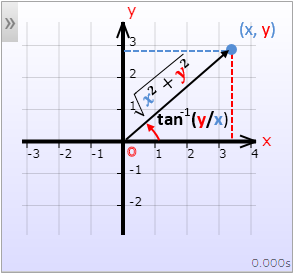
As shown in Fig 1, regardless of the location of the point (x,y), by the Pythagorean Theorem, we have: r = √(x2 + y2) We also have tan(φ) = y/x where φ is the polar angle (or phase) — the angle that the vector (a, b) makes with the positive x-axis, or the argument of the complex number a+bi.
By definition of tan-1, we have φ = tan-1(y/x) if (x,y) is in the first or fourth quadrant (where x > 0), as tan-1 always gives an angle between -π/2 and π/2.
Note that the above also holds for x = 0, which implies r = |y|, and φ = ±π/2 depending on the sign of y.
Note: If (x,y) is in the second or third quadrant (where x < 0), we must add or subtract π to tan-1(y/x) to obtain the correct polar angle (phase).
To summarize:
Cartesian (Rectangular) to Polar (Phasor) Form
For a point with Cartesian coordinates (x,y), the polar form is:
(r,φ), where
Note that φ is not unique, they all differ by an integer multiple of 2π.
Converting Polar to Cartesian Coordinates
Converting polar coordinates to Cartesian coordinates is straightforward using the definitions of trigonometric functions on a unit circle. Referring to the following figure, it is clear that the point (r,φ) in the polar coordinate system and the point (rcos(φ), rsin(φ)) in the Cartesian coordinate system coincide.

So we have the following formula for converting polar coordinates to Cartesian coordinates:
Polar (Phasor) to Cartesian (Rectangular) Form
For a point with polar coordinates (r,φ), the Cartesian form is:
Note: The above conversion formula holds even if r is negative. If r < 0, then
x = |r|*cos(φ+π) = -r*(-cosφ) = r*cosφ, and similarly,
y = |r|*sin(φ+π) = -r*(-sinφ) = r*sinφ.